

Guardian

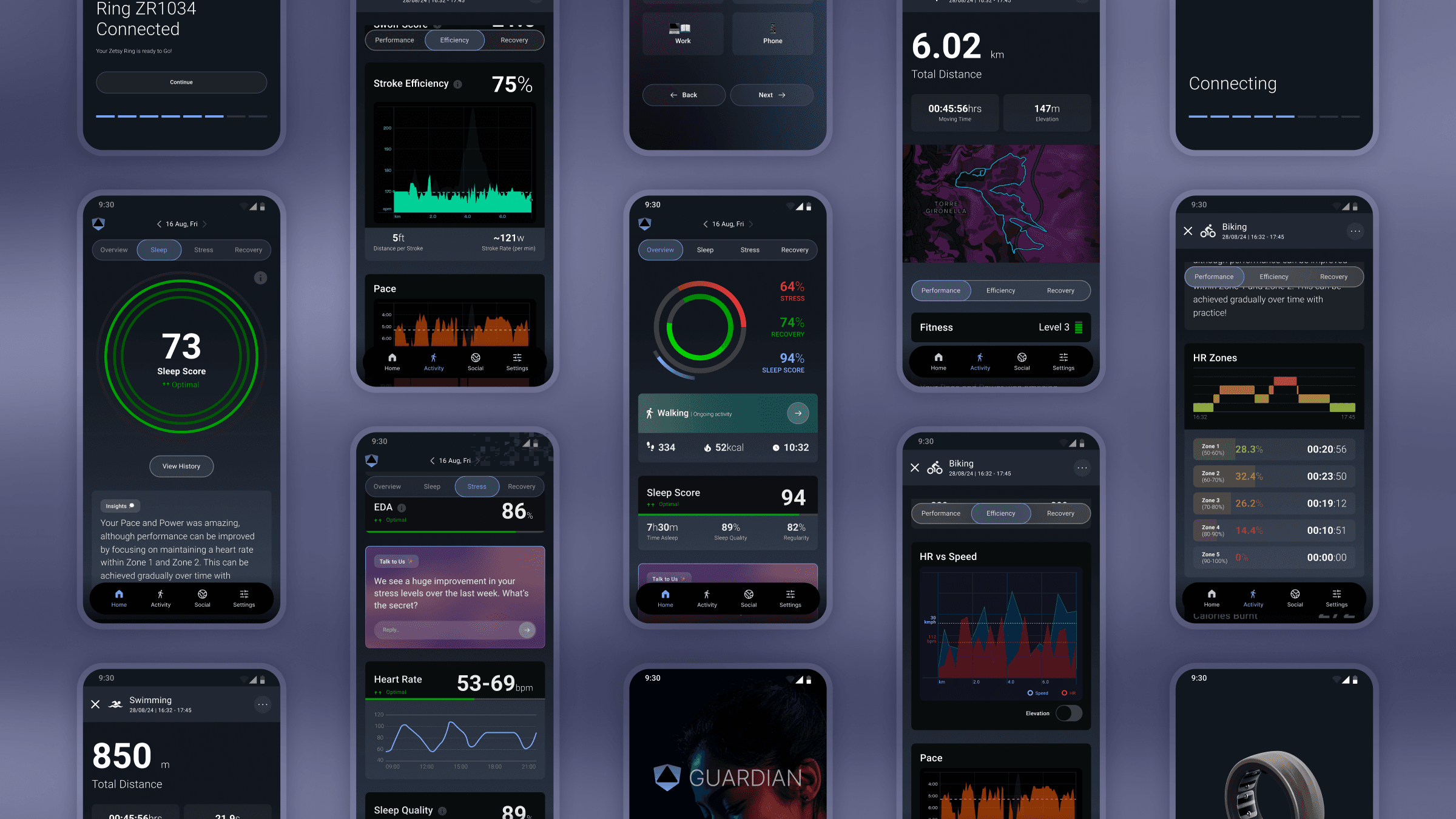
Overview
What if your wearable stopped showing you numbers and started telling you what to do?
Problem
Wearables produce more data than ever, but most apps stop at charts. Users see numbers, no meaning — and close the app without knowing what to do.
Approach
Consolidated signals from three devices into three human-legible pillars — Sleep, Stress, Recovery. Every screen leads with one primary score, then a plain-language narrative, then supporting data. Sport-specific layers (SWOLF for swimmers, power output for cyclists) make post-workout summaries feel genuinely relevant.
Outcome
Retention — Narrative-first design replaces the "open and close" loop with a daily check-in worth returning to.
Engagement — Contextual prompts that invite user input turn the home screen into an adaptive conversation.
Trust — Sport-specific metrics signal the system understands the user's activity, driving deeper long-term use.
The Problem
Wearables give you numbers. Guardian gives you meaning.
The rise of wearable tech has given users more biometric data than ever, yet most apps stop at charts. Heart rate is a number. HRV is a number. Sleep stages are a number. But none of that tells you what to do or why it matters.
Guardian's challenge: elevate raw physiological data into a holistic longevity dashboard that feels intuitive, actionable, and reassuring—without overwhelming the user with complexity.

Product Scope
Three devices, one unified health picture.
Guardian integrates data from a ring, a watch, and a cardiac patch, each selected for the signals it reliably captures in everyday use.
The sensor stack:
Accelerometer — movement and activity patterns
HRM & PPG — heart rate and heart rate variability
EDA — physiological stress response
SpO₂ — oxygen saturation trends
Skin Temperature — circadian and recovery cues
The challenge: sensors produce metrics. Metrics produce noise. To avoid overload, all signals are intentionally aggregated into three core health pillars:
Sleep — restoration, circadian stability, and sleep quality
Stress — acute and chronic physiological load
Recovery — adaptation, fatigue, and readiness
Sensors feed metrics. Metrics feed domains. Domains feed insights. Users never think about which device tracked what, only how their body is responding over time.
UX Philosophy
Interpretation first, data second, always.
Three principles shaped every design decision:
Supportive, not prescriptive
Recommendations are framed as contextual guidance, not alerts. Guardian stays calm and reassuring, even when flagging concerns.
Meaning over measurement
Users understand why a metric matters before engaging with the data itself.
One signal at a time
Each screen anchors on a single primary signal. Reducing cognitive load isn't simplification—it's clarity.
Core Flow 1
Getting oriented from day one
CHALLENGE
Health apps need a lot of context upfront. Most make this feel clinical or tedious.
SOLUTION
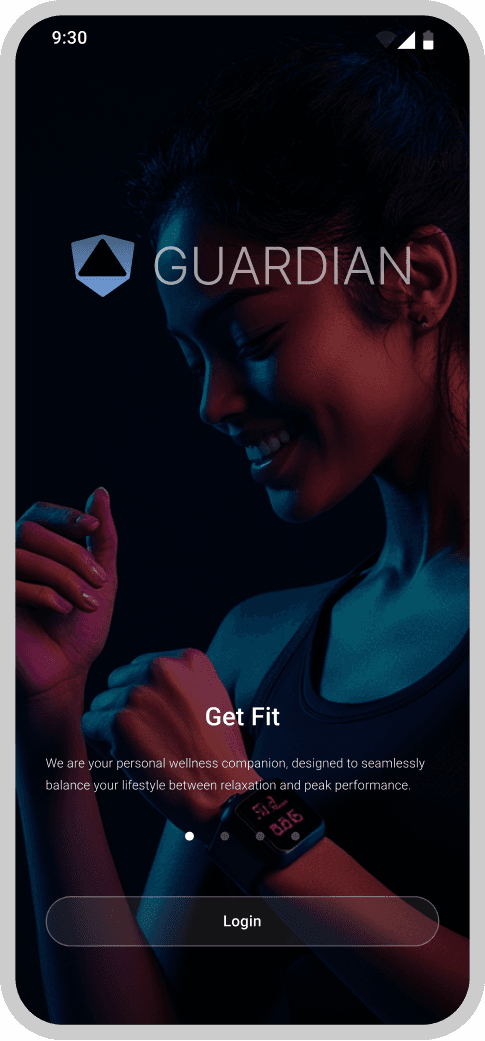
Onboarding leads with device setup: charging, Bluetooth pairing, confirmation, and correct wear, framing technical steps around what directly impacts data quality, not the hardware itself. Clear progress states and calm success feedback keep the process reassuring.
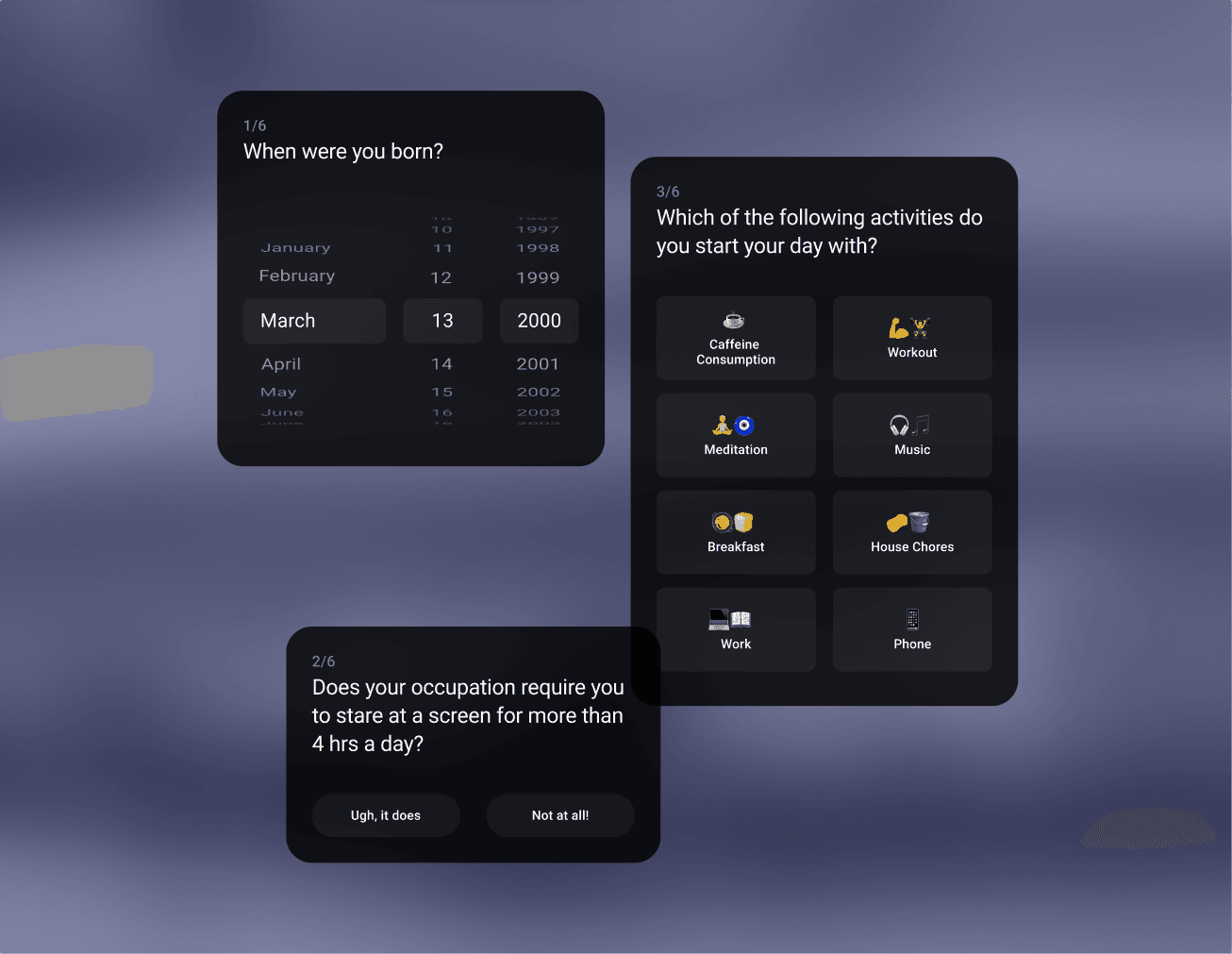
Once devices are connected, a short questionnaire captures age, work patterns, and daily routines. These inputs provide essential context for interpreting future trends and anomalies, without positioning the experience as medical or diagnostic.
RESULT
A personalized foundation that feels lightweight and easy to complete.
Core Flow 2
A single view of what matters most
CHALLENGE
Presenting all metrics at once dilutes their meaning.
SOLUTION
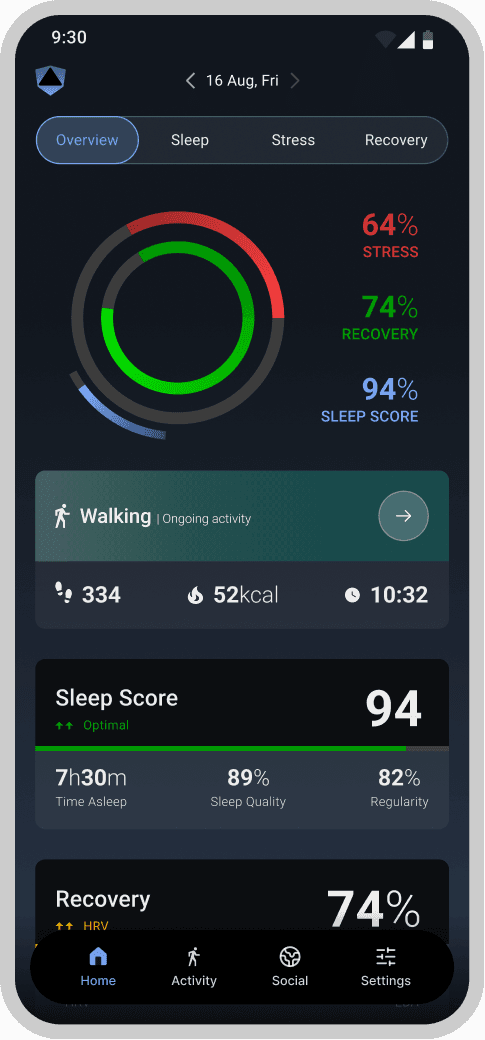
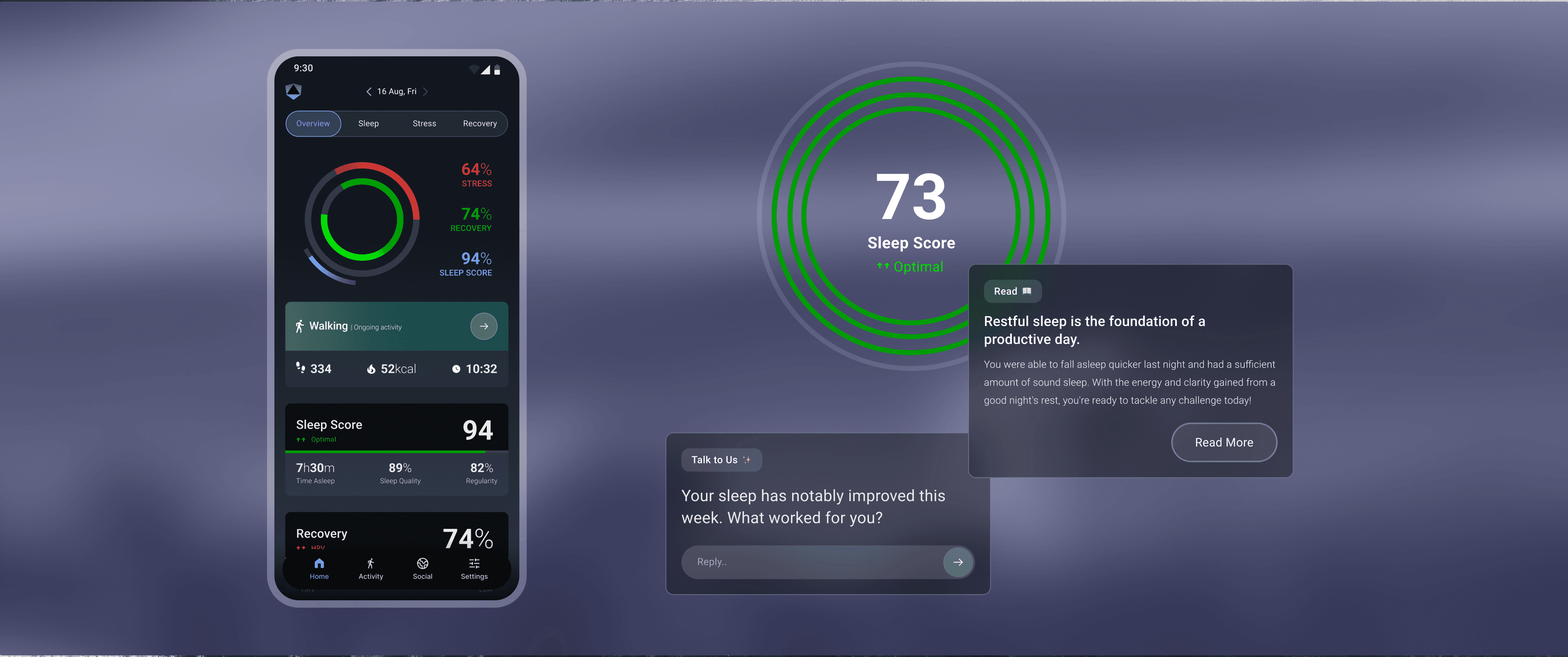
Health data is organized into three domains—Sleep, Stress, and Recovery—each representing a distinct physiological state. This mirrors how the body actually works: sleep restores, stress accumulates, recovery determines readiness.
Each layout follows a clear hierarchy:
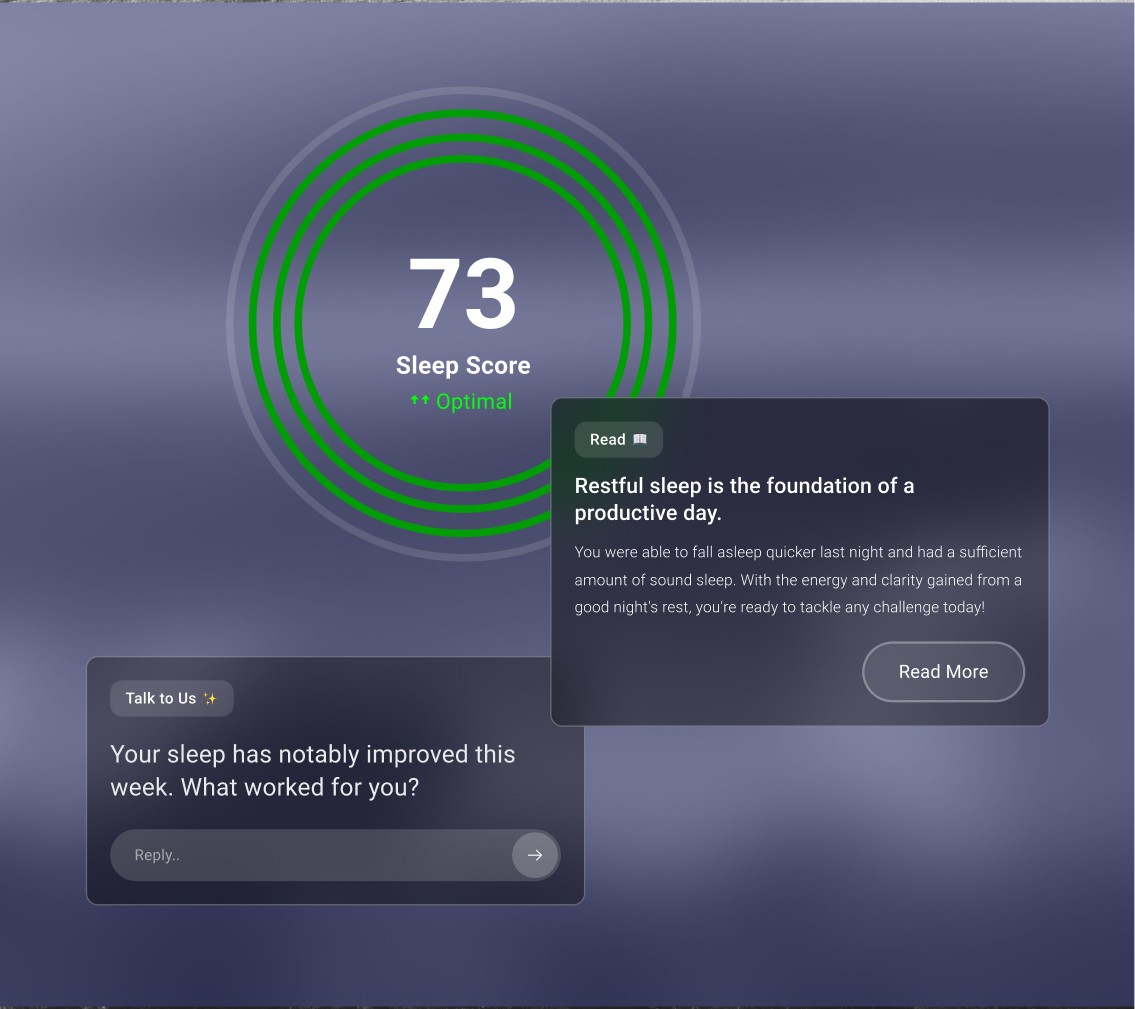
A single primary score anchors the screen
Narrative insights follow
Supporting metrics and trends sit beneath
Contextual prompts invite user input at meaningful moments: improvements, anomalies, patterns, feeding qualitative context back into the system. Over time, Guardian builds a clearer picture of individual patterns, turning the home screen into an adaptive conversation rather than a static display.
RESULT
Users understand their health state at a glance without needing to interpret charts or dig through metrics.
Core Flow 3
Sport-specific insights, not generic summaries
CHALLENGE
Different activities stress the body differently. A single metric set across all workouts misses the point.
SOLUTION
Each sport has its own interpretation layer:
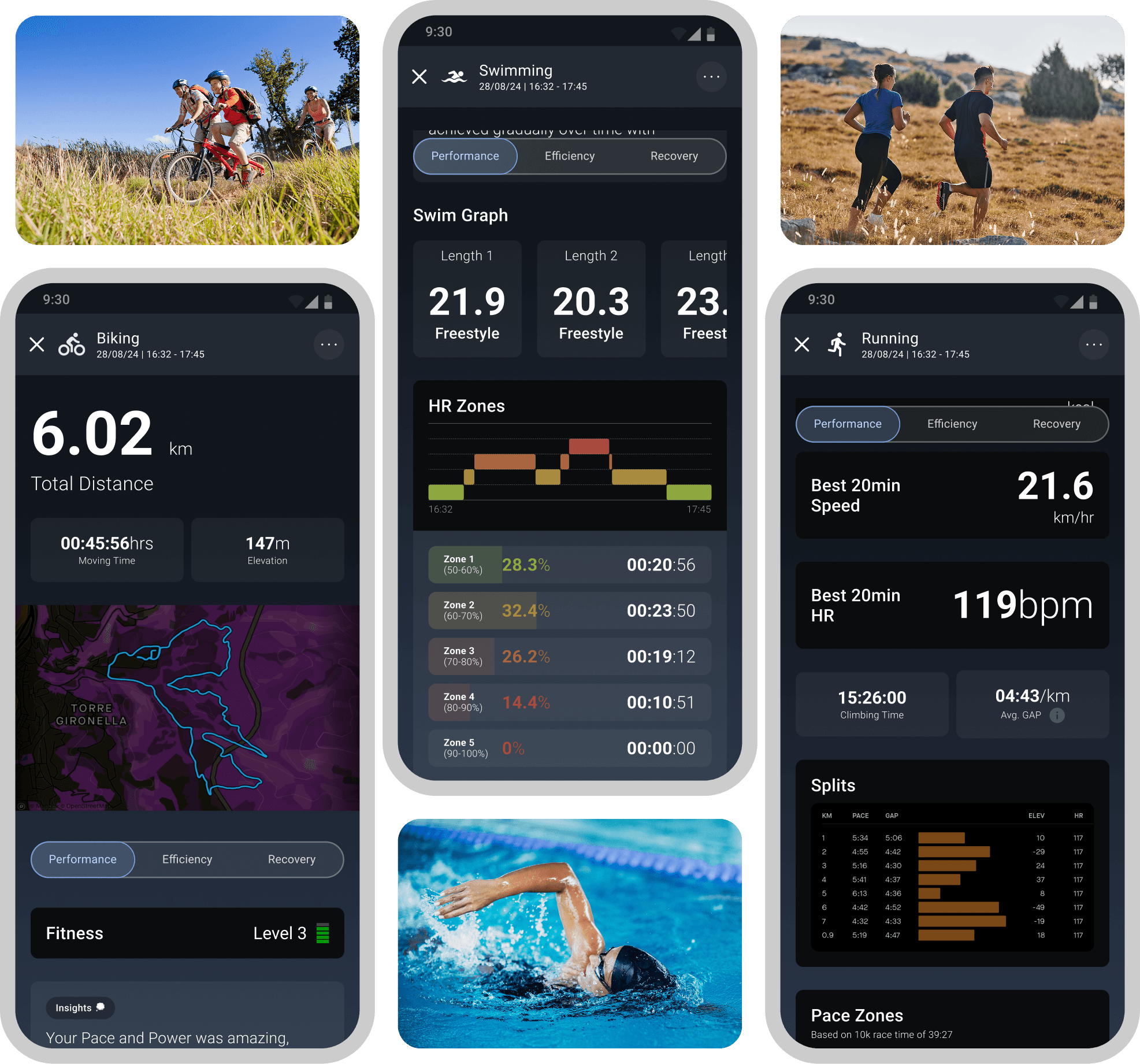
Biking — power output and elevation
Running — pace and cadence
Swimming — stroke efficiency, turn time, and SWOLF
Every post-workout flow follows a consistent three-lens structure: Performance, Efficiency/Form, and Recovery. Narrative insights and recovery cues help users reflect on effort and cost—turning each session into a clearer understanding of how their body responds and adapts.
RESULT
Workout summaries feel personalized and insightful, not generic, building trust that the system actually understands the sport.
Design System
Clarity under complexity, with restraint.
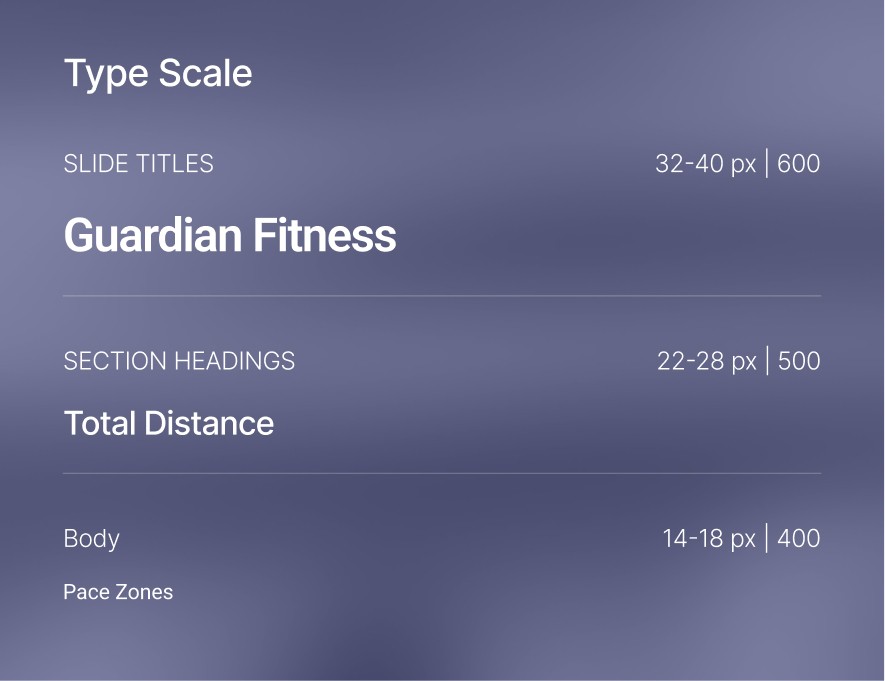
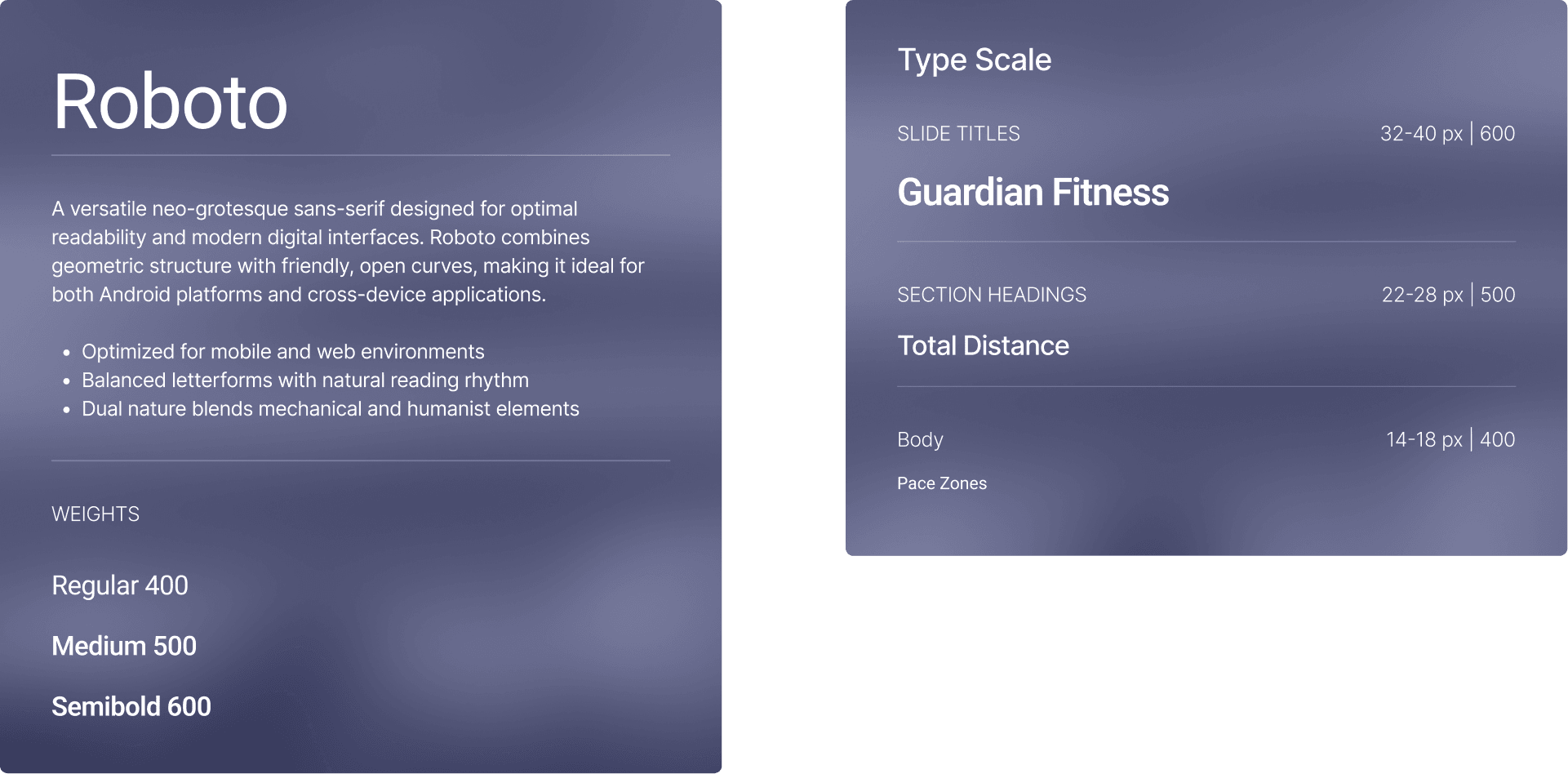
The design system maintains clarity through discipline: each screen anchors on a single primary focus with a clearly defined score hierarchy, while a consistent vertical rhythm guides attention naturally across every view. A dark, reflective visual tone supports introspection and sustained use, with color applied sparingly—only to encode meaningful thresholds, never decoratively. Reusable components like score rings, metric cards, and insight blocks ensure coherence and scalability as the system grows.
The Outcome
Biometric tracking becomes a health narrative.
Guardian reframes what wearables are for. Sport summaries read like analyst insights rather than generic achievement badges. Domain-based grouping reinforces long-term health perspective over short-term gamification.
Design plays a central role in bridging the gap between physiology and everyday life—translating complex sensor data into experiences that feel familiar, digestible, and worth returning to.

Key Learnings
Complexity needs structure, not reduction.
Aggregation is a design decision
The choice to funnel all sensor data into three domains wasn't just organizational—it was the core UX decision that made Guardian usable. Without it, the system would have been another data dump.
Interpretation precedes visualization
Every time a metric was surfaced without context during design reviews, it created confusion. The principle of leading with why it matters before what it says became a hard rule, not a preference.
Sport-specificity builds trust
Generic workout summaries feel hollow. When users see metrics that actually reflect their sport—SWOLF for swimmers, elevation gain for cyclists—they trust the system more and engage more deeply.
Why This Problem Is Hard to Solve
Unifying multi-device data, meaningful interpretation, and calm UX is rarely done together.
Multi-device data unification
Data from a ring, watch, and cardiac patch needs to be normalized, deduplicated, and prioritized. Most products avoid this complexity by locking to a single device.
Meaningful interpretation at scale
Turning HRV, SpO₂, and EDA into plain-language insights that are accurate, contextual, and non-alarming requires both domain knowledge and careful copy decisions.
UX that doesn't overwhelm
Health data is inherently dense. The instinct is to show everything. Guardian's hardest design challenge was deciding what not to show—and trusting that less, explained well, is more.
