
Cohesify

Overview
What if the ritual your team already dreads could be the thing that actually brings them together?
Problem
Hybrid work eliminated the unplanned moments that built team cohesion. Companies responded with newsletters and virtual socials — but 81% of employees found them performative. The gap wasn't effort, it was authenticity.
Approach
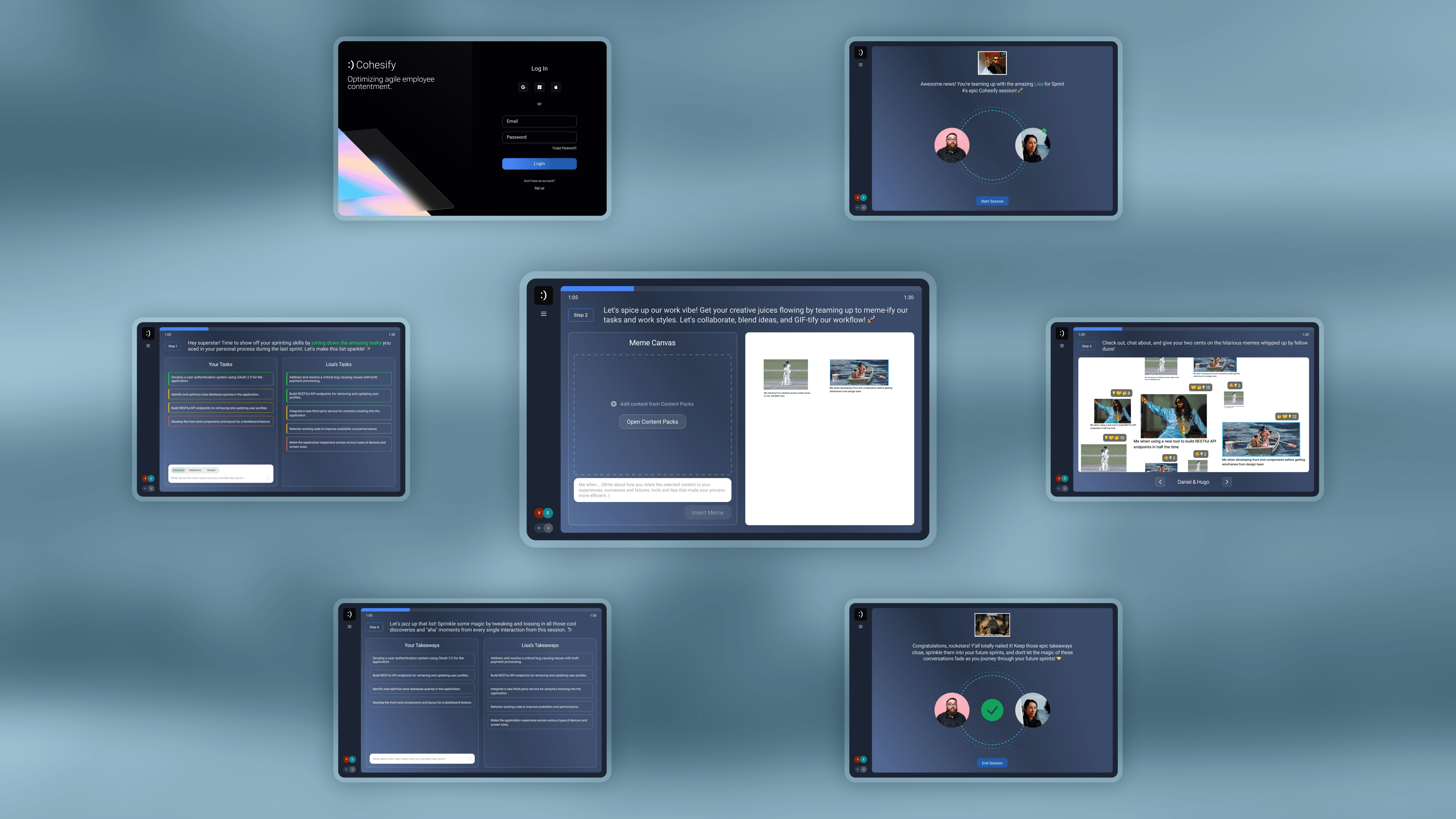
Redesigned the agile retrospective around meme co-creation. A four-phase, 30-minute session pairs teammates 1-on-1 (auto-rotating to prevent repeats), walks them through listing sprint tasks with mutual visibility, co-creating a meme that reflects their experience, reacting to the team's memes in a live cloud visualization, and refining AI-generated takeaways.
Outcome
Engagement — All test participants stayed active throughout, including introverts, who could participate via emoji reactions.
Retention — Lives inside an existing sprint ritual, so adoption requires no behaviour change — just a better version of something teams already do.
Growth — After one session, pairs reported greater approachability and easier collaboration, with memes surfacing team-wide patterns that traditional status updates missed.
The Context
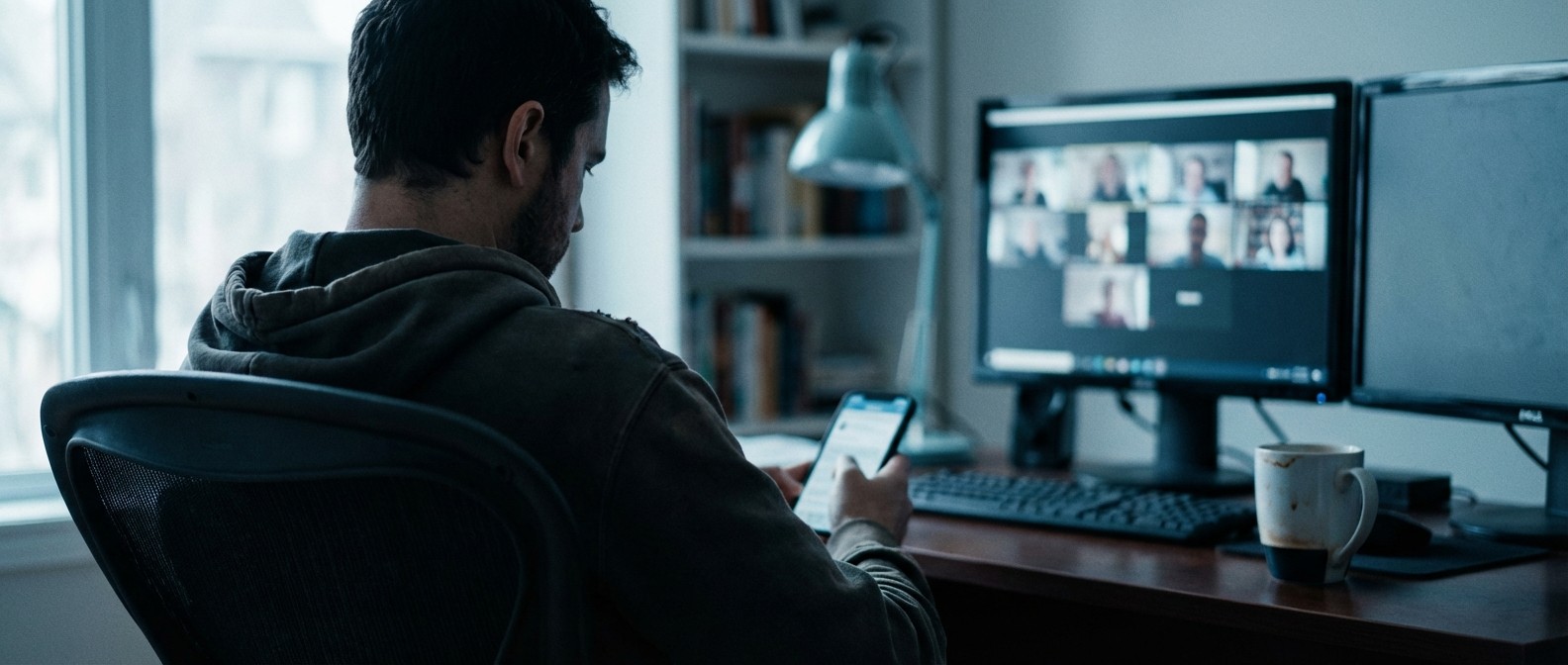
Hybrid work killed the casual connections that held teams together.
By 2024, 80% of Indian companies had adopted hybrid arrangements. Productivity metrics improved, but something less measurable broke—hallway conversations, impromptu brainstorms, casual check-ins all disappeared. Teams felt disconnected, employees burned out, and innovation suffered.
Organizations noticed and responded with newsletters, virtual social hours, and "chai pe charcha" sessions. None of it worked. These efforts felt forced, performative, and failed to create genuine connection.

What Research Revealed
Employees aren't disengaged—they're unconvinced.
Research with 16 entry to mid-level employees at IT companies surfaced a pattern of quiet disillusionment:
81.2% felt communication from management was insufficient
81.2% believed happiness policies were implemented as formality, not genuine concern
75% felt company decisions lacked transparency
71% acknowledged wellness policies existed but saw no improvement in their actual wellbeing
Company newsletters and HR-initiated ice-breakers were widely ignored
The problem wasn't a lack of initiatives. It was a lack of authenticity. Employees had stopped trusting corporate communication entirely.
The Insight
Memes are micro-narratives. Storytelling builds teams. What if they're the same thing?
Two parallel research threads converged on a single breakthrough.
Storytelling's Power in Organizations
builds empathy, shares tacit knowledge, and transforms communication from transactional to meaningful. Stories connect past experiences to future actions, creating a shared narrative that guides teams through change.
Memes as Micro-Narratives
function as condensed stories—they carry plot, conflict, cultural context, and emotional resonance. Crucially, they let viewers map their own experiences onto familiar content, creating instant relatability and opening space for reflection.
The breakthrough: Combine storytelling's organizational benefits with memes' natural engagement to transform the most critical team ritual—the agile retrospective.
Why Retrospectives?
The right intervention already exists. It just needed redesigning.
Agile retrospectives are structured reflection moments that teams perform every sprint. They already had the right intent: reflect, share, improve, but in practice felt mechanical and disengaged.
Redesigning retrospectives around meme co-creation meant:
Replace forced social sessions with organic conversation starters
Turn abstract reflection into creative, shareable artifacts
Bridge gaps between diverse work styles (introverts, workaholics, social butterflies)
Create authentic moments of connection through shared pop culture
The Session
Four phases, each solving a specific communication breakdown.
A typical Cohesify session unfolds through four carefully designed phases, each solving specific communication challenges identified in research:
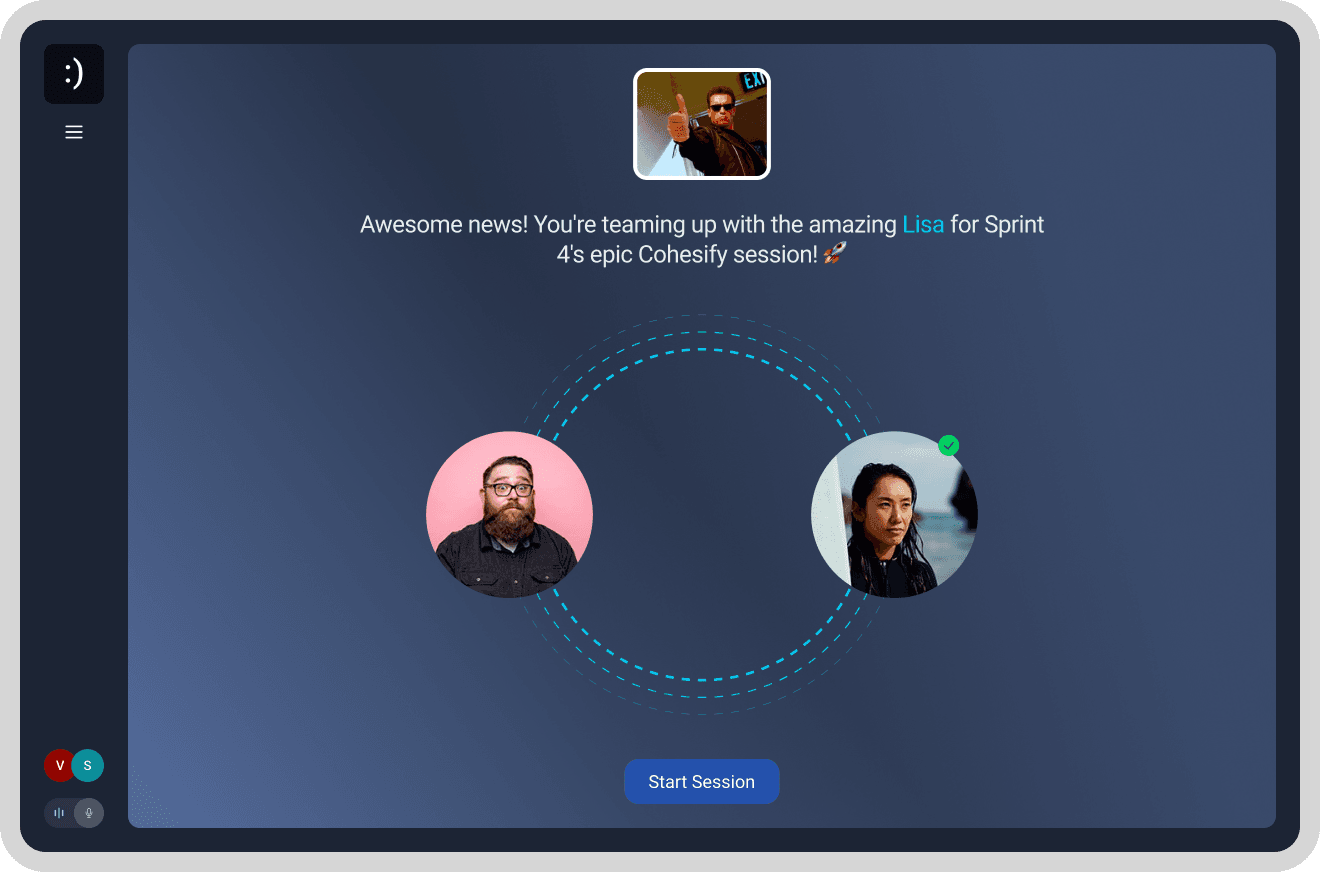
Smart Pairing: Building Unexpected Connections
The session begins with automatic smart pairing. The system tracks and randomizes matches to ensure pairs don't repeat, systematically building cross-team connections over time. Integrated voice chat activates immediately, recreating the casual conversation of in-person retrospectives.
Testing revealed a consistent truth: participants felt far more comfortable opening up to one partner than performing for a group. The 1-on-1 dynamic solved the "forced chai pe charcha" problem at its root: connection can't be mandated, but it can be designed for.
RESULT
Even introverts participated comfortably. Conversations naturally flowed between work process and casual topics without prompting.


Phase 1: Task Listing — breaking the ice naturally
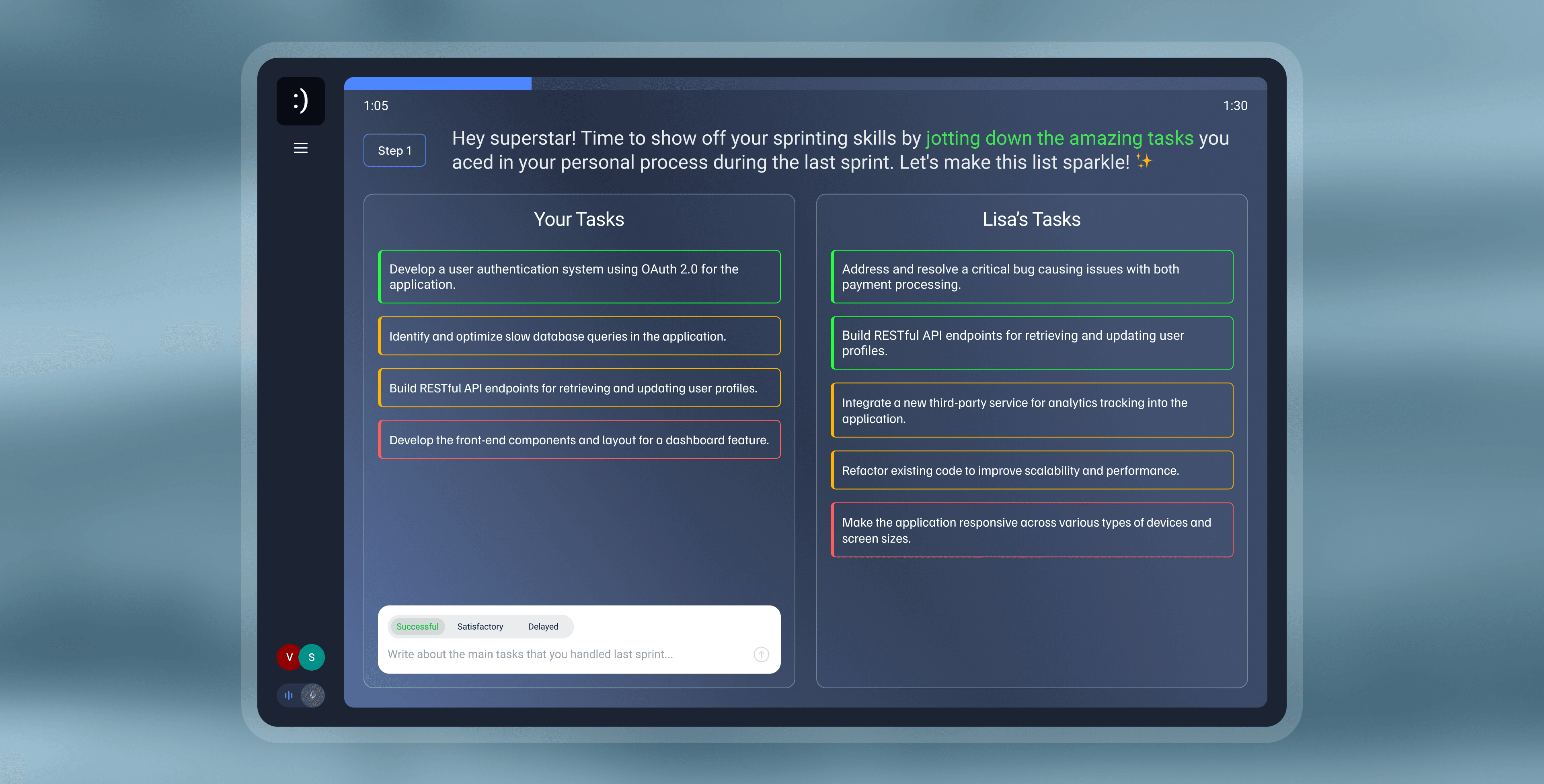
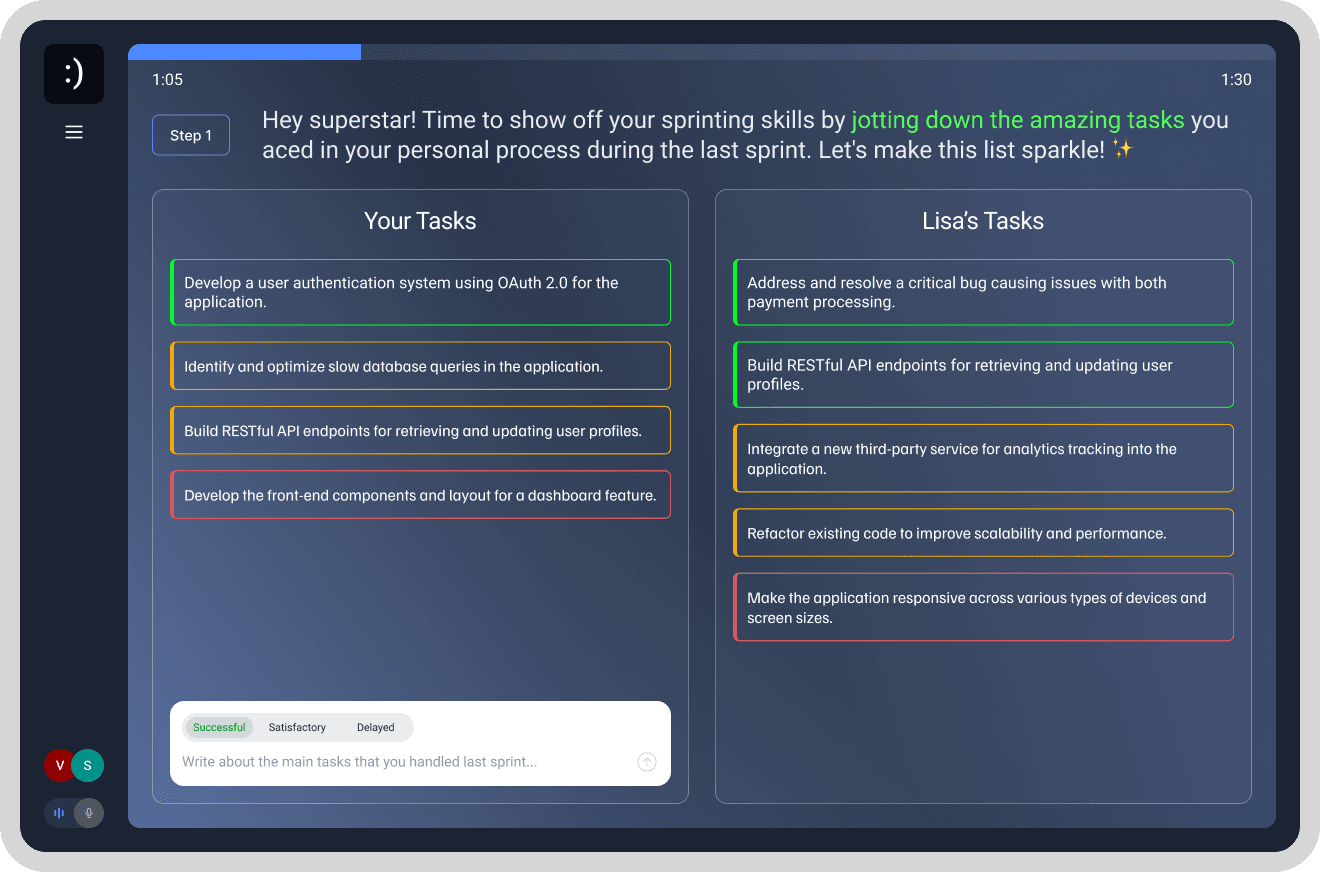
Teammates list their sprint tasks side-by-side in a split-screen interface, each color-coded by status: green for successful, yellow for satisfactory, red for delayed. Mutual visibility creates immediate context without forcing interaction—seeing that Lisa tackled the API integration while you handled front-end makes conversation emerge organically.
A clear progress bar and timer provide structure without rigidity. The copy—"Hey superstar! Time to show off your sprinting skills"—signals this isn't corporate formality.
RESULT
Pairs built empathy through visible context, and the color-coded statuses addressed the 75% who craved more transparency in how work was actually going.
Phase 2: Meme Co-creation — structured creativity
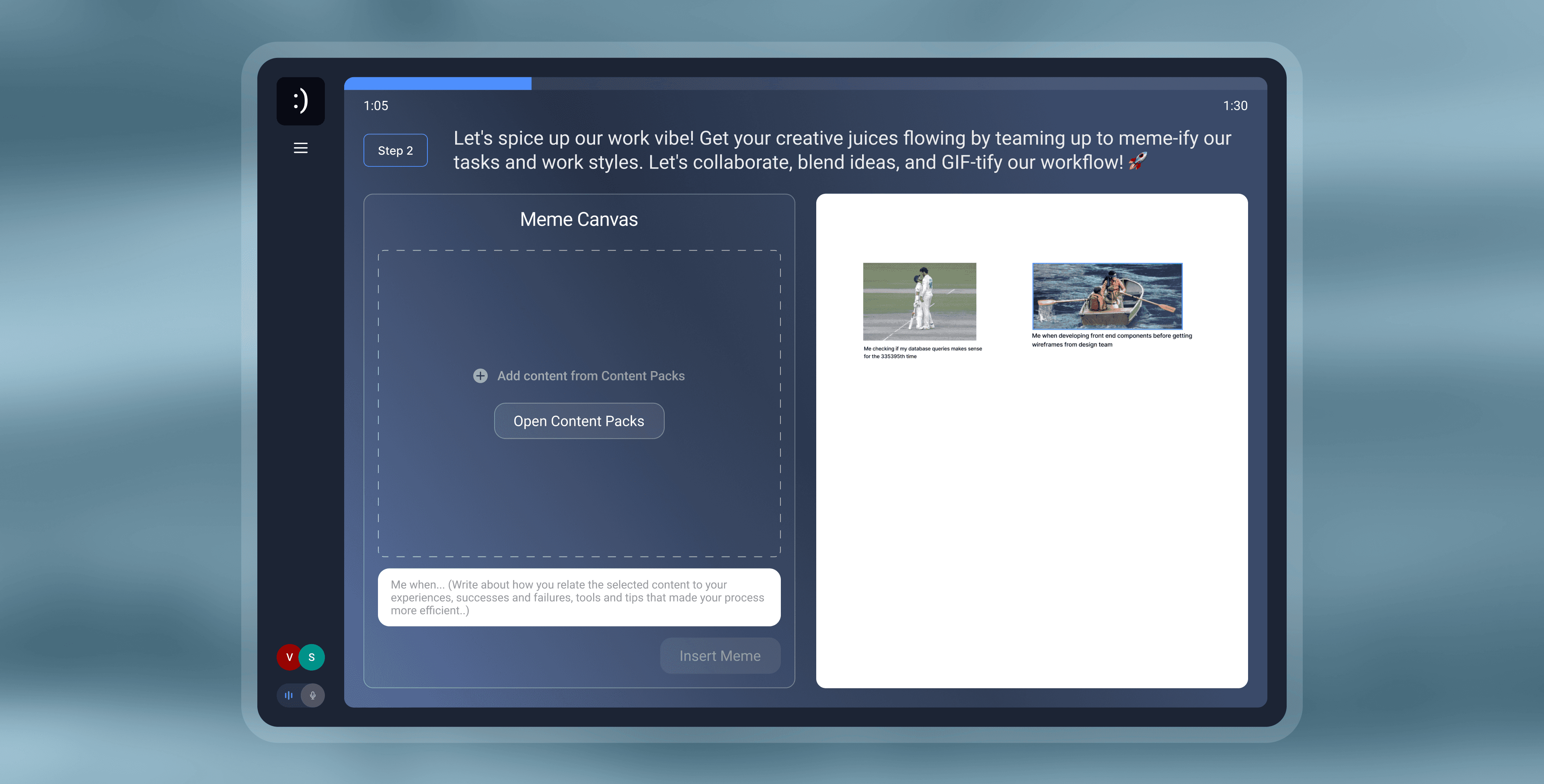
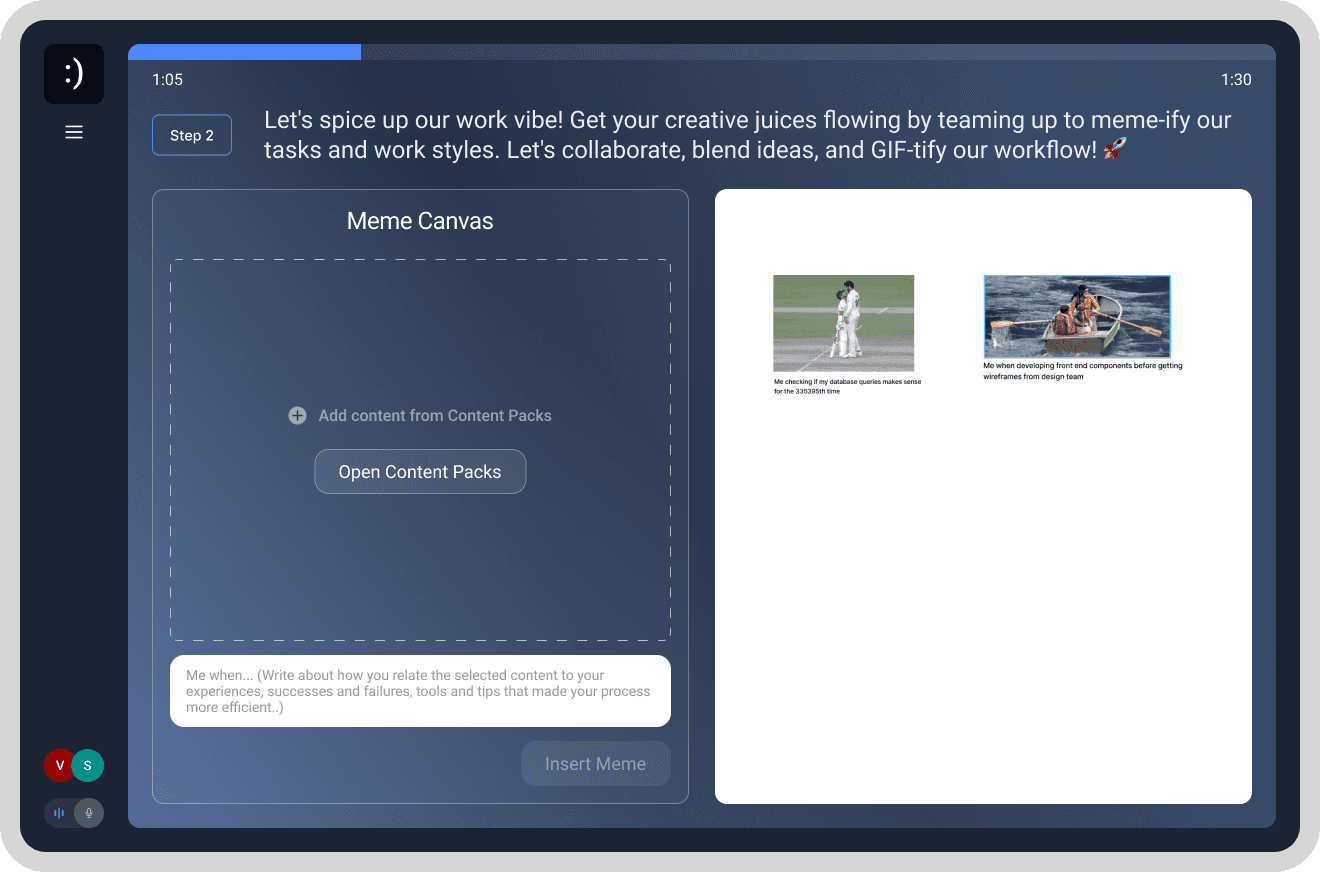
The interface presents curated content packs organized by trending topics: recent movies, music videos, current events, internet culture. Rather than open internet search—which testing showed led to decision paralysis—constantly updated packs provide structure without limiting creativity.
Finding an image of someone confidently presenting while everything burns in the background, both teammates laugh through voice chat: "That was me during the database migration." The meme becomes a vehicle for storytelling, not just reporting.
RESULT
The constraint paradoxically increased creative freedom. Participants made unexpected connections between images and their work that didn't surface in traditional retrospective formats.
Phase 3: Meme Viewing — collective curation
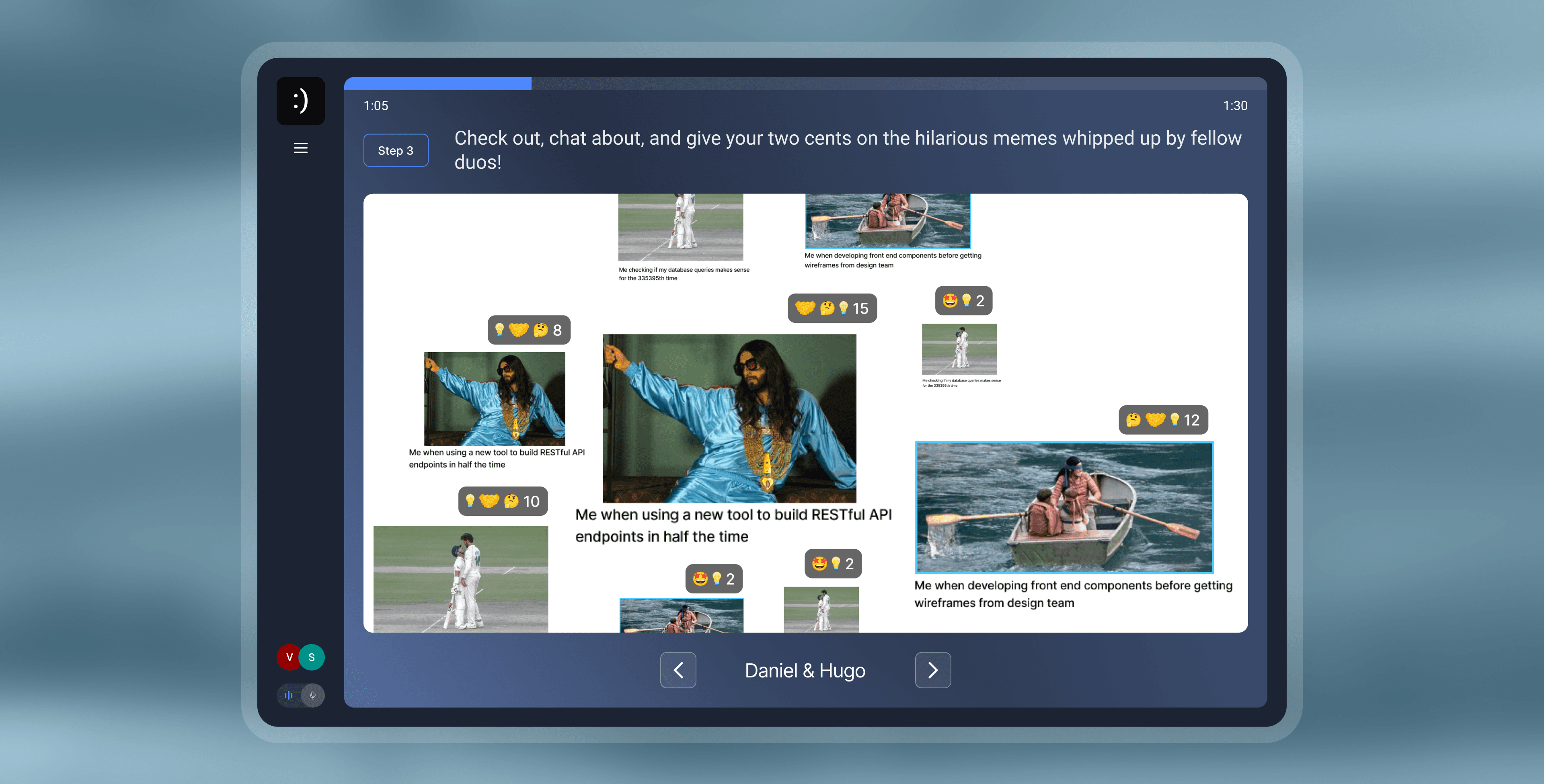
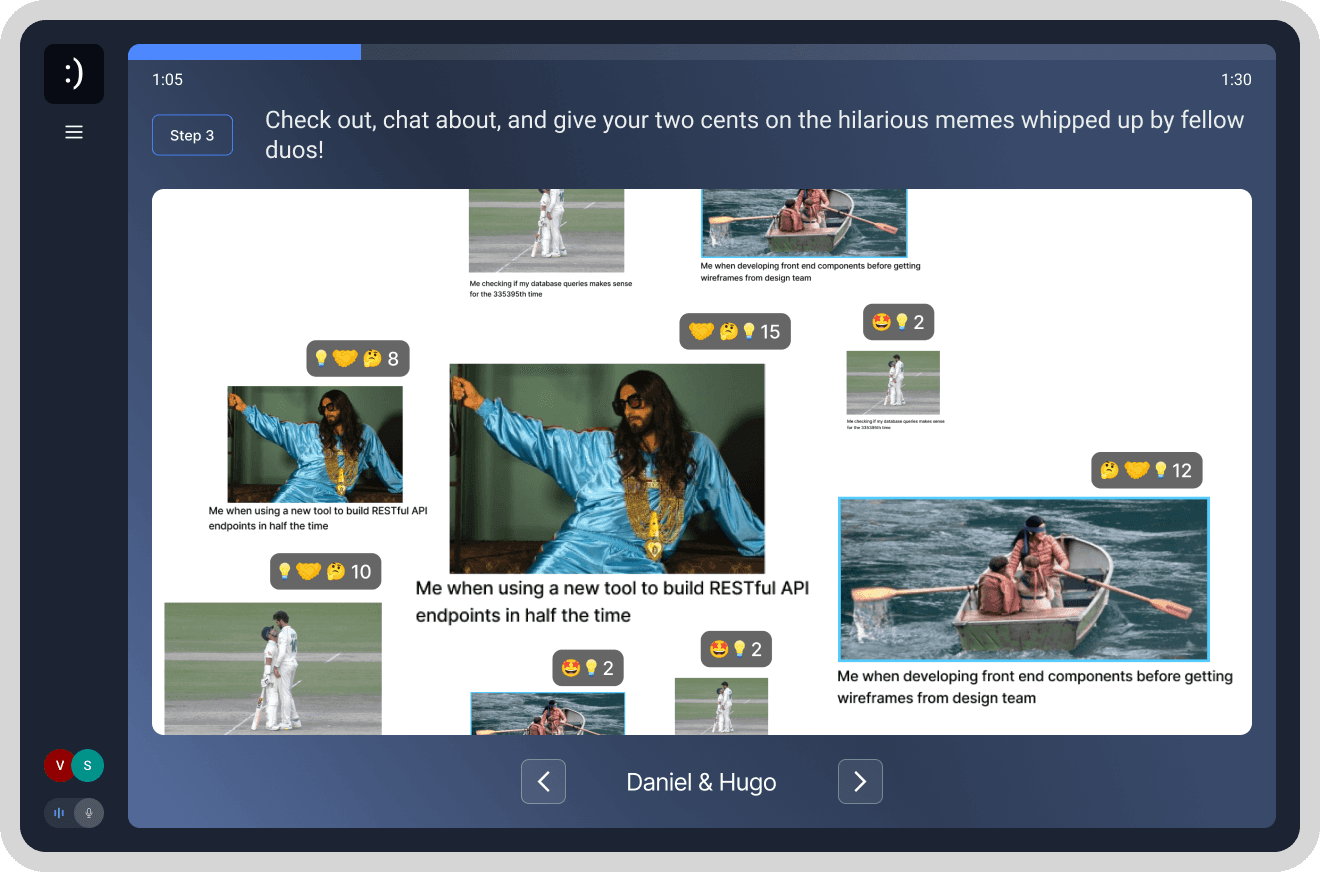
All pairs' memes appear in a dynamic cloud visualization where highly-reacted memes grow larger and move to the center in real-time. A meme about wrestling with new tools gets 15 reactions and grows prominently—suddenly revealing this wasn't an isolated struggle but a team-wide pattern.
The emoji reaction system gives everyone a voice without forcing verbal participation. Introverts add a thinking-face emoji to signal alignment. Social butterflies react actively. Skeptics see authentic peer experiences rather than corporate messaging. The design serves all personas simultaneously.
RESULT
Participants described the viewing phase as both quicker and more informative than traditional status updates. Collective reactions created an emergent narrative of what mattered most to the team.
Phase 4: AI-Assisted Takeaways — reflection without the burden
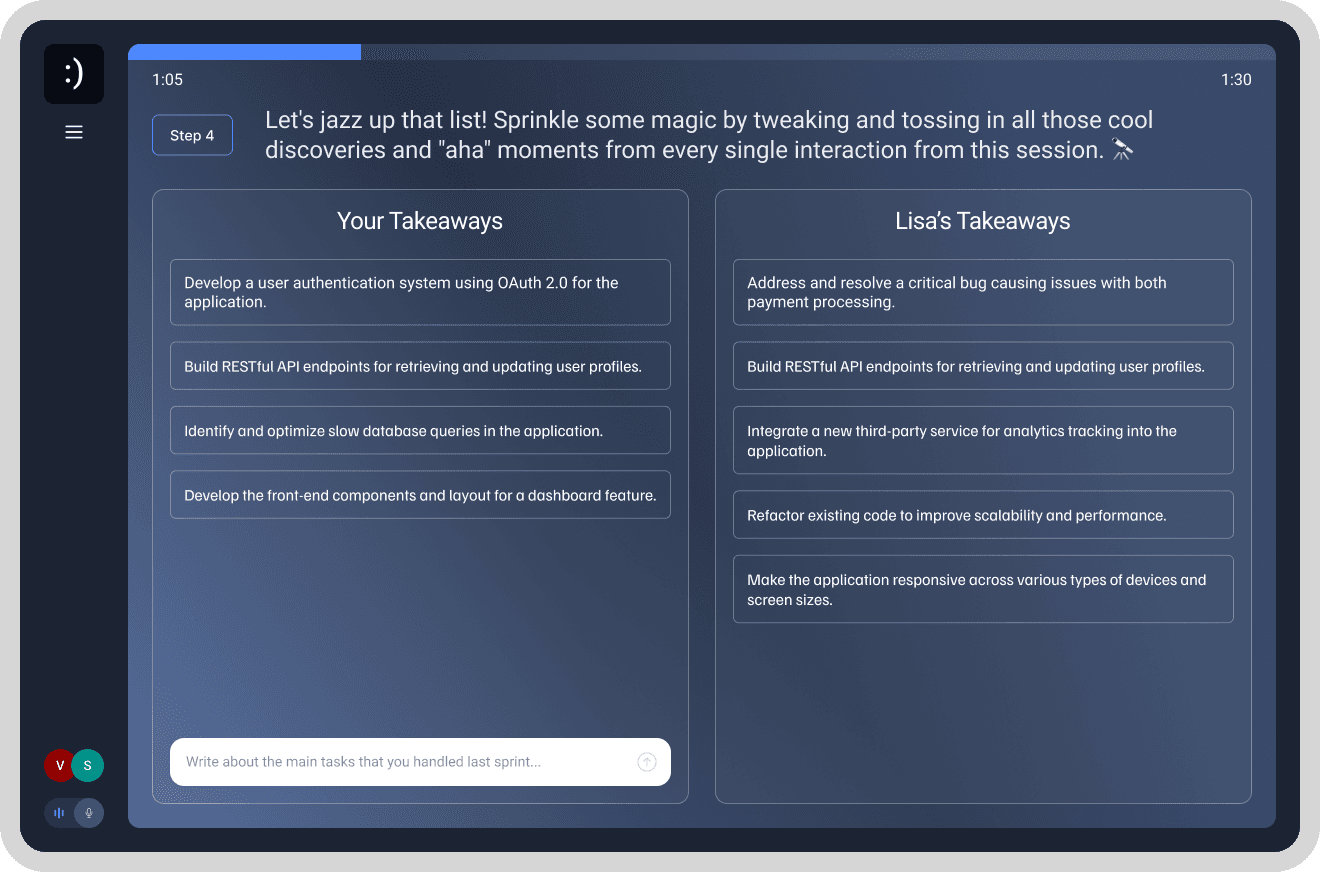
AI-generated takeaways appear in a split-screen format based on which memes each person reacted to: "Consider scheduling knowledge-sharing for new tools" and "Front-end team may benefit from design system documentation." Participants can fully edit, refine, and add personal notes—the system provides direction, not prescription.
This emerged from a critical testing insight: meme reflection alone left gaps, but asking for extensive writing after creative work felt burdensome. The system bridges this tension, positioning text reflection as efficient summarization rather than additional heavy lifting.
RESULT
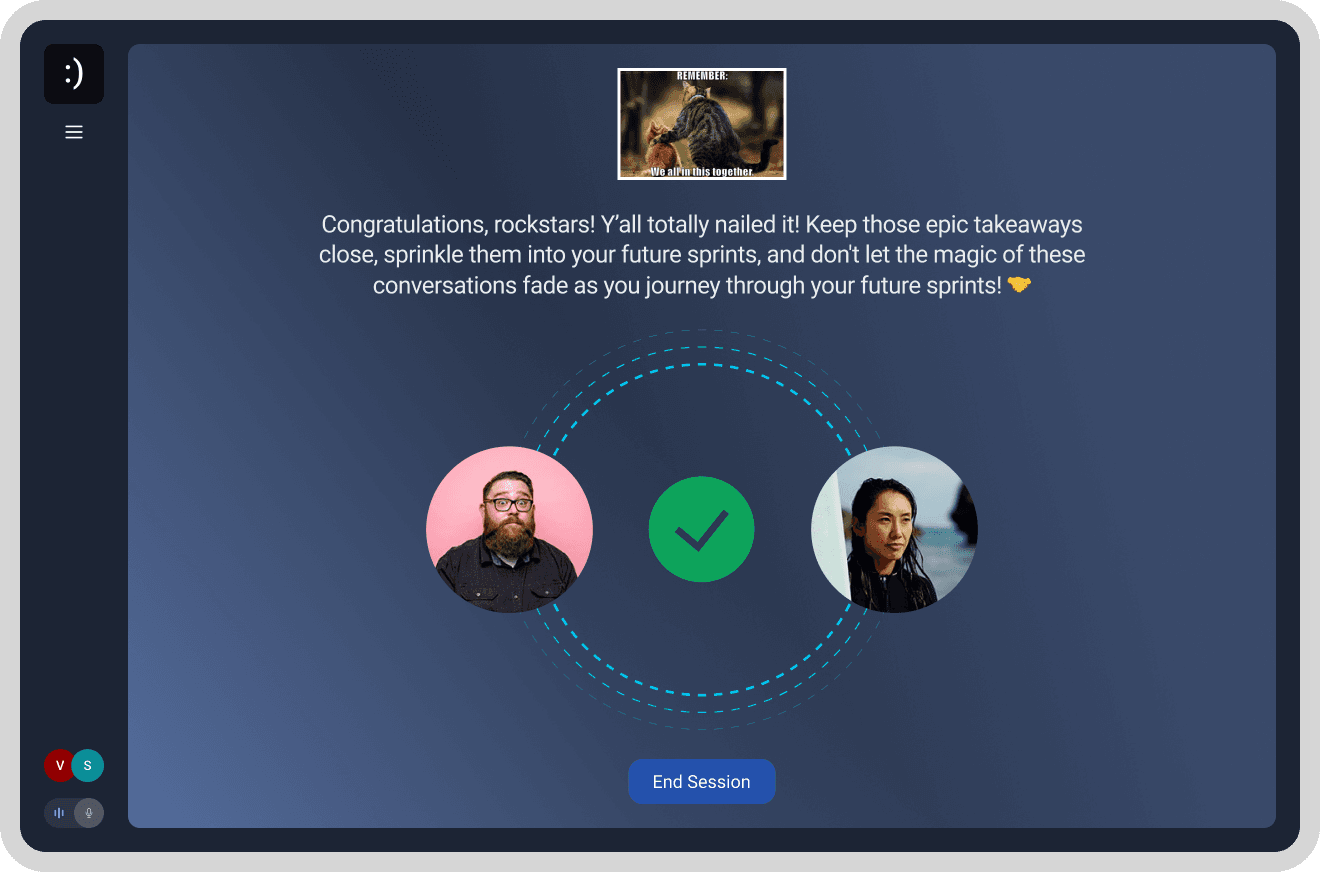
The entire session took 30 minutes. Teammates learned more about each other's work styles than a month of status updates revealed.

Design System
Professional enough to be trusted. Human enough to feel real.
Colour System
A deep blue palette (#4483FA, #085CA0) establishes trustworthiness and professionalism—this is still a work tool. But vibrant status colors (bright green for success, orange for satisfactory, red for delayed) and the lime green highlights add energy without undermining credibility.
PRIMARY BRAND COLOUR
Interactive Blue
#4E88FE
Buttons, clickable elements, interactive components
BG & SURFACES
Main Gradient
#526A98 → #313F5A
Primary app background, main surface gradient
Light Gray
#DCDFE5
Input fields, cards, high-contrast surfaces
Pure White
#FFFFFF
Container backgrounds
Charcoal Blue
#1C2434
Deeper surfaces, nav bar
TYPEOGRAPHY AND ICON
White
#FFFFFF
Primary text on dark backgrounds, high contrast headings
Black
#000000
Primary text on light backgrounds, highest emphasis
Type System
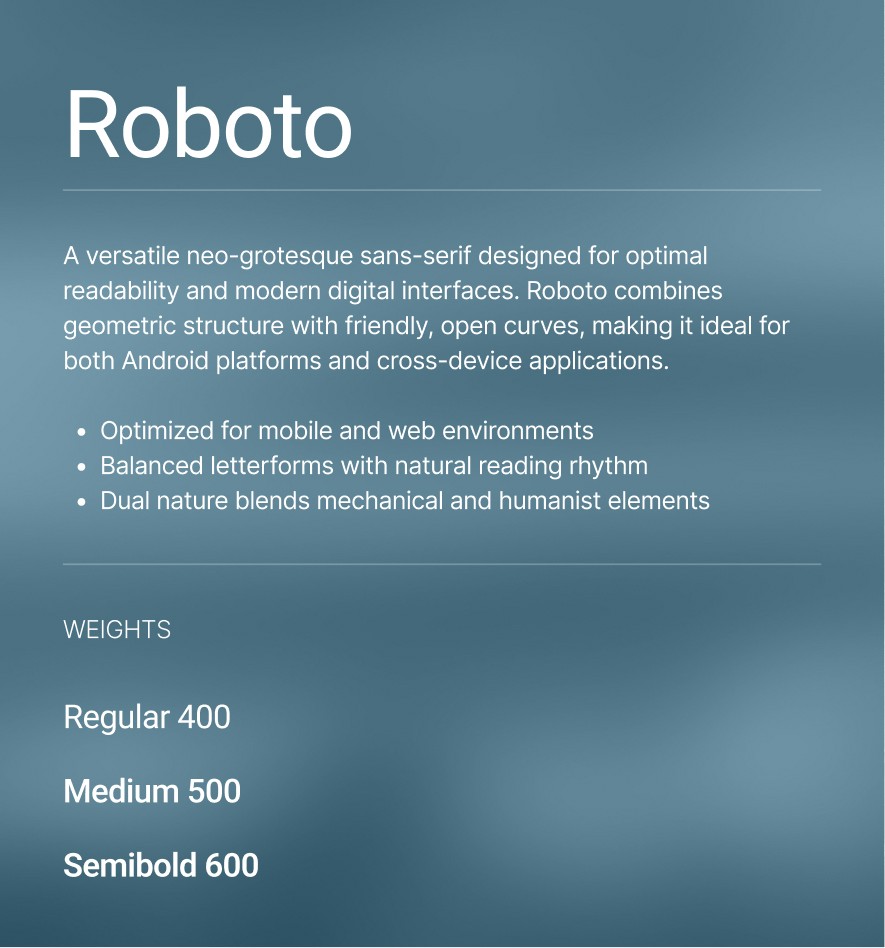
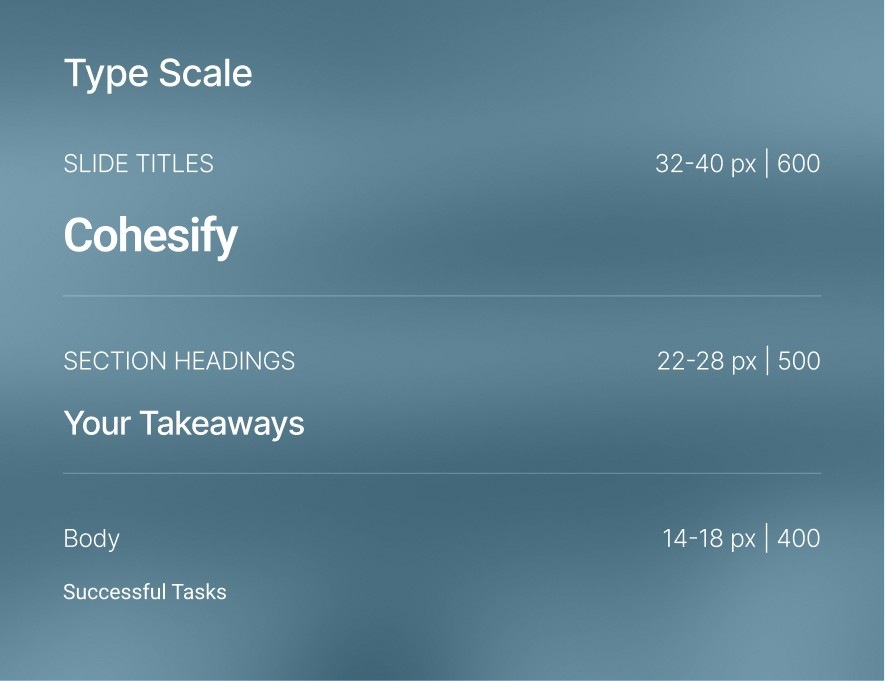
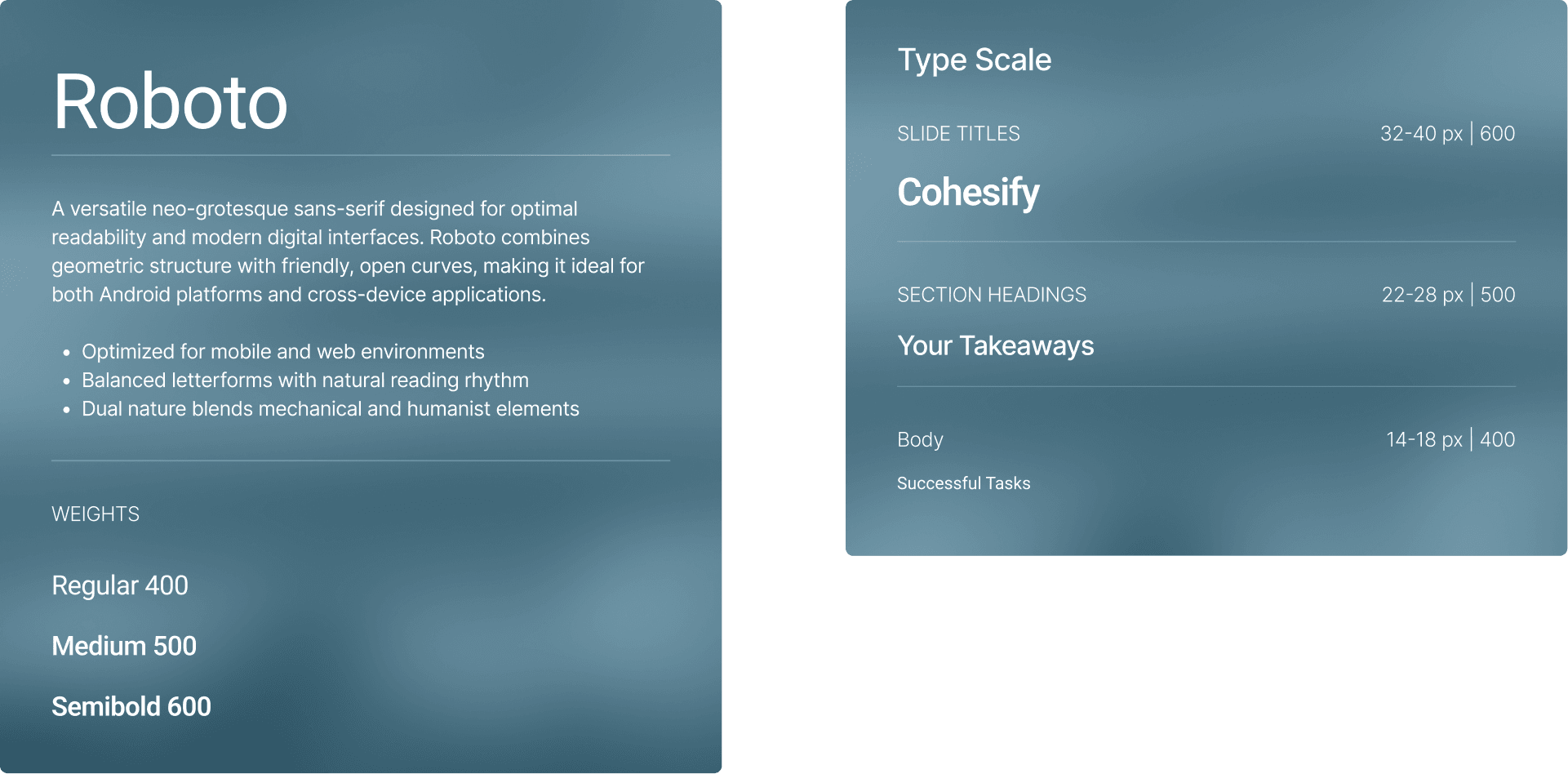
Roboto provides modern clarity while the copy itself—"Hey superstar! Time to show off your sprinting skills"—signals this isn't corporate speak. The contrast between professional structure and casual language reinforces that authenticity doesn't require sacrificing organization.
Layout: Structured Space for Spontaneity
Split-screen interfaces make pairs' work mutually visible without being invasive. Progress bars and step indicators provide orientation without feeling restrictive. White space and gradient accents keep the interface breathing and modern.
Key Learnings
Authenticity Can't Be Forced, But It Can Be Designed For
The failure of "chai pe charcha" sessions revealed that you can't mandate connection. But you can create conditions where it emerges naturally—through shared creative acts, mutual vulnerability, and removing performance pressure.
Constraints Enable Creativity
Curated content packs and structured phases didn't limit participants—they liberated them from decision paralysis and allowed focus on meaning-making rather than format-choosing.
Balance Multiple Work Styles Simultaneously
The personas (optimist, skeptic, social butterfly, workaholic, introvert) initially seemed to need different solutions. But the right design serves all: voice chat for social butterflies, emoji reactions for introverts, structured phases for workaholics, genuine content for skeptics.
Meet People Where They Already Are
Rather than fighting against employees' preference for visual, bite-sized content and pop culture references, we made these the foundation. The solution worked because it aligned with existing behavior patterns rather than trying to change them.
Looking Forward
Cohesify demonstrates that internal communication tools don't have to choose between professional rigor and human connection. By understanding the underlying mechanics of engagement—storytelling, shared creativity, structured spontaneity—we can design interventions that feel genuine because they are.
The next evolution could explore:
Scaling beyond pairs to gradually expand team understanding
Longitudinal tracking of how meme themes evolve as team culture shifts
Integration with existing project management tools for seamless workflows
Cross-cultural content packs that respect diverse communication styles
Most importantly, Cohesify proves that solving for one specific moment—the agile retrospective—can transform the broader challenge of remote team connection. Sometimes the best way to fix culture isn't through sweeping initiatives but through redesigning the small rituals that teams perform together, week after week, sprint after sprint.
